
Zu Verschenken
A box of fairy tale wooden blocks, found on a Berlin doorstep

A young woman falls down a well.
In the deep dark, she disappears.
When she opens her eyes, she finds herself in a strange meadow.
◼
A woman with a crown of flowers meets a lover behind a planetarium.
They walk through a city built on a swamp. One night, they cross a threshold.
◼
On the step, a cardboard box.
In thick, black marker: zu verschenken, to give away.
The lover points inside.
He likes to say he has the eye of a crow.
Inside is just another box.
It’s wooden with retro-painted font: 6 Bilder Deutsche Märchen, a box of stories.
I don’t want it.
I want my lover to grow up.
It’s late, and so is the bus.
“Come,” he says. “It’s a puzzle.”
I roll my eyes and carry the box home.
I can always toss it later.
◼
At my table, we lift the lid.
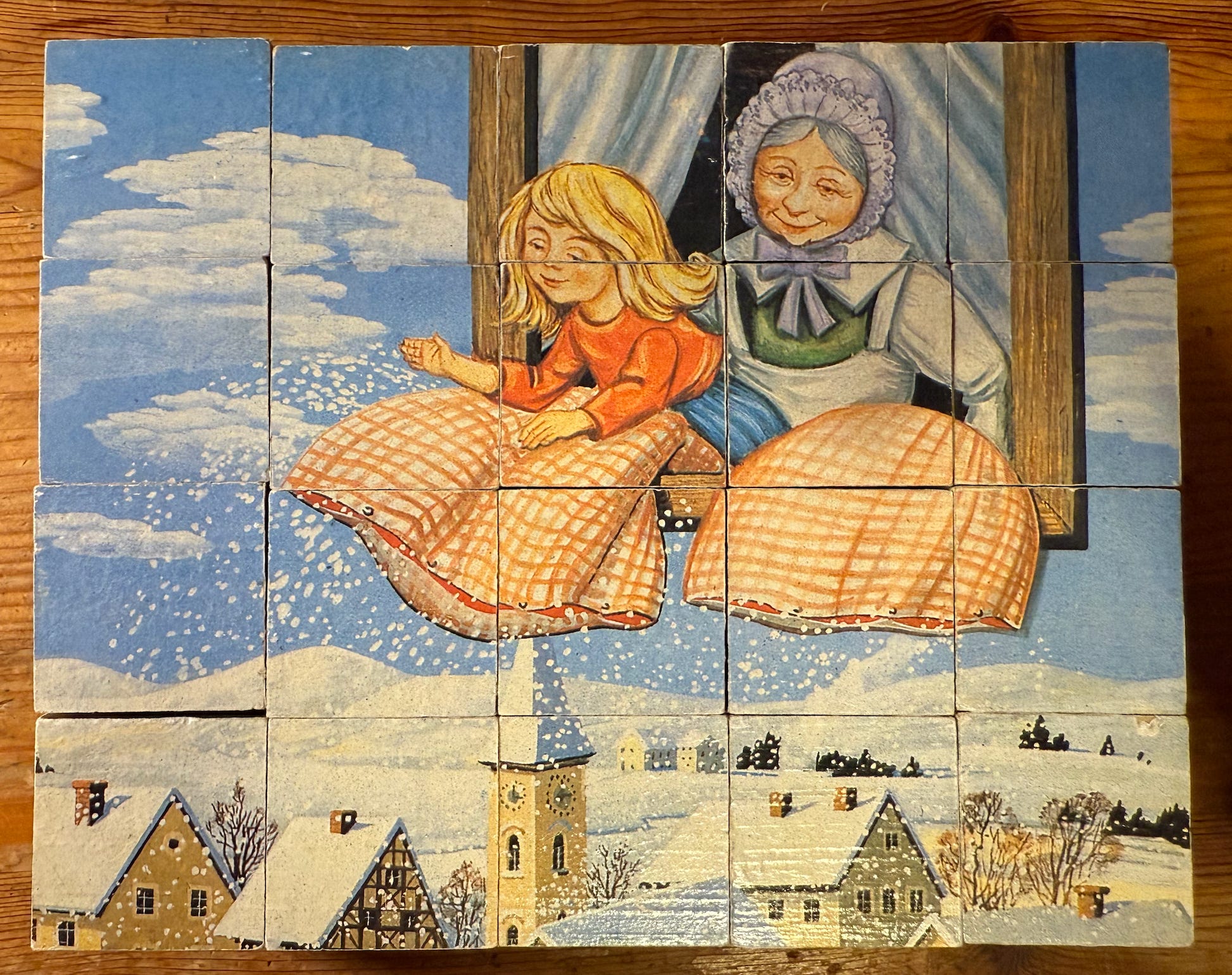
The puzzle is twenty wooden blocks.
Each small enough to hold in a fist. All old enough that the paint is faded.
Each cube has six faces. Turn the block and the face changes.
A wolfish grin. A crowned frog. A princess’s curls.
Every face is a clue: elbows on a windowsill, dancing legs, a gingerbread door.
We look for patterns.
Branches don’t match the trunks.
Clouds don’t fit the sky.
Even the grass flows backwards.
A children’s puzzle shouldn’t be this hard.
◼
We turn the blocks and it starts to snow.
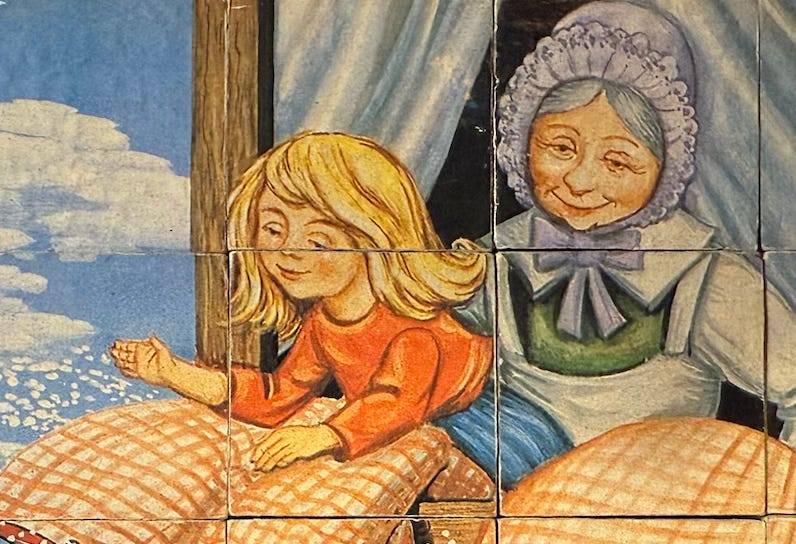
Snow falling on a village. Snow thrown out an open window, like salt from a pair of hands. A story of an old woman and a young woman making the weather from their house in the sky.
◼
By age six, I’d made up my mind about reading. Awake in my bunkbed, I stared into the darkness, convinced it might never happen for me. There were too many words.
◼
There’s a story from Hessen about a woman who jumps down a well.
In the deep dark, she disappears.
When she opens her eyes, she finds herself in a strange meadow.
She meets a loaf of bread that demands to be taken out of an oven.
She follows orders from a tree that wants its apples shaken down.
She arrives at the house of an old woman named Frau Hölle.
She helps with the housework.
I skim the Wikipedia page.
The diligent young woman is rewarded with gold. She’s called Goldmarie.
◼
I get gold stars.
I pass tests.
I underline metaphors.
In high school, I join a reading club.
On the first day, instead of books, we name our favorite film.
I’m first.
Without hesitation, I say, Miss Congeniality, the 2001 rom-com with Sandra Bullock as an FBI Agent undercover in a beauty pageant.
The president of the club snort-laughs.
This snort follows me through an English major, through journalism.
I’m not a reader, but I don’t tell anyone.
I buy books,
I set goals,
I say, it’s on my list.
There is no list.
◼
There are doves, apple trees and a silver spoon. The blocks clack together, worn at the edges where other hands have turned them.
When the lover goes home, I put the puzzle away. Maybe I want to savor it. Maybe I don’t want to solve it alone.
When I move apartments, it goes into storage with my unread books.
Years pass.
◼
Frau Hölle and Goldmarie make the weather. They shake out the bedding and feathers turn to snow.
◼
There’s another character, though. Goldmarie’s lazy sister.
She, too, jumps down the well.
In the deep dark, she disappears.
When she opens her eyes, she finds herself in a strange meadow.
She doesn’t touch the bread because she doesn’t want to get dirty.
She ignores the tree because she doesn’t want apples falling on her.
She does housework but won’t do it every day.
When she leaves Frau Hölle, she gets covered in pitch.
◼
When I first read “pitch,” I thought it meant cow dung. For years, I believed lazy women were destined to be covered in shit.
Be honest, didn’t you think so, too?
If you didn’t, Reader, you probably know pitch is tar, the resin used to waterproof ships.
◼
In German, pitch is das Pech.
Pech means bad luck.
A Pechsträhne is a streak of bad luck.
A Pechvogel is an unlucky bird.
Pechmarie is the name of the lazy sister, covered in Pech.
That’s how the story ends.
◼
But if you turn the blocks, there’s another version. Here’s how I tell it:
Covered in pitch, Pechmarie hides. Alone, she gets lazier.
One day, she falls into a river. Instead of drowning, she sails. The pitch makes her waterproof.
She crosses oceans. She sees the world. She goes down other wells and returns with stories.
“This is my story,” she says. “My sister fell down the same well and has her own.”
Goldmarie found wealth. Pechmarie found freedom.
◼
In Hessen, when it snows, people still say Frau Hölle is shaking out her bedding. In Berlin, when it snows, I think of the well.
◼
I take my blocks out of storage.
A girl with a wolf, red as a fox. A woman with three birds. Seven dancing goats.
I turn the cubes, reading the images.
Siblings in the woods. A frog at a well. White-as-snow feathers falling on a town.
◼
There’s an old story about a young woman who falls down a well.
She does housework for Frau Hölle.
She’s happy until she gets homesick.
That’s when she decides to return.
Goldmarie doesn’t earn gold for her hard work or her obedience.
Like Pechmarie, she’s rewarded when she decides to return.
◼
The blocks slide into place.
A town under snow.
Children in a forest.
A princess and a frog.
I turn the cubes, reading stories I didn’t choose, stories that came to me in a box.
◼
The blocks keep coming,
like gifts pushed into my hands.
There is no list,
but I turn the stories.
◼
Twenty blocks with six faces.
This is the first.
She closes the box, and the story continues.
Twenty Blocks is a series about birds, books, boxes and other objects that arrive uninvited with a piece of the puzzle.